

Only one hundred miles from Barbedos, more and more birds are visiting Orinoco. Two of them, seemingly exhausted, spend the whole night on our solar panel and left with the rising sun. Others catch fish around our sailing yacht in daytime. Yesterday and today after sunrise, a group of three Brown Boobies (Weißbauchtölpel) was following us for an hour, supposedly diving for flying fish that is abundant in this part of the Atlantic Ocean.

Day 20: Squall
We did have some trouble with squalls the last evenings and nights. Squalls are local and small (a few miles wide) depressions that bring clouds, gusty winds and rain and that are fueled by the energy of warm water (now 28 degrees). Of course, we try to reef our sails before a squall hits our yacht, and not during the hit. Therefore, we closely observe them with the help of the full moon and radar. Sometimes we feel surrounded by squalls that appear out of thin air and have unpredictable courses. Moreover, they always seem to hit when dinner is served…

Day 19: Mink Whale
First we thought a shark was following our boat. But then it was a lone seven to eight meter long mink whale (Zwergwal) that was very gracefully diving besides and under us for three hours. We saw it’s white stomach many times and it is assumed that they use their white stomach to scare and chase small feeding fish (like sardines or smaller). We believe this predator used our sailing yacht to better chase fish. The feeding fish might get confused by Orinoco’s waves or might be trapped between the boat and the whale.

Day 18: Rowing Boat
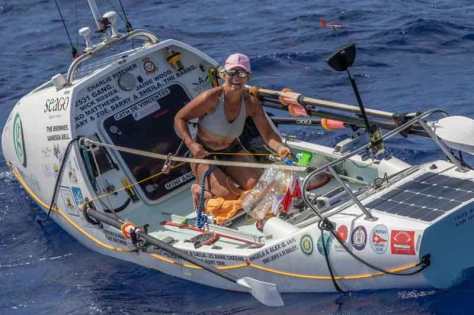
Suddenly our VHF radio (UKW Funk) went off. Somebody told us something that sounded like “rolling boat” (that was what we understood) and a position. A few minutes later our AIS (Automatic Ship Identification) displayed a 7 meter long vessel called “true blue” about 20 miles away (14.21’996N 50.40’582W). No further radio contact was possible. Two hours later, now five miles away from the surprisingly slow moving (2,5 to 3 knots) boat, we started
to look out. But even one mile away we saw nothing. VHF radio contact now verified that it was “a rowing boat with two oars (Ruder)” and one woman on board. After establishing that rescue was not asked for, we offered tuna and mahi mahi steaks. However, Jona opted for fresh fruits and cheese. Thus, some of our last apples, oranges and lemons were gone… but happily so, as we were proud to help such a great woman to achieve her unbelievable goal: to reach Barbedos in one week, after seven weeks on the ocean – in a rowing boat.
Her website: rowaurora.co.uk.

Day 17: Milky Way
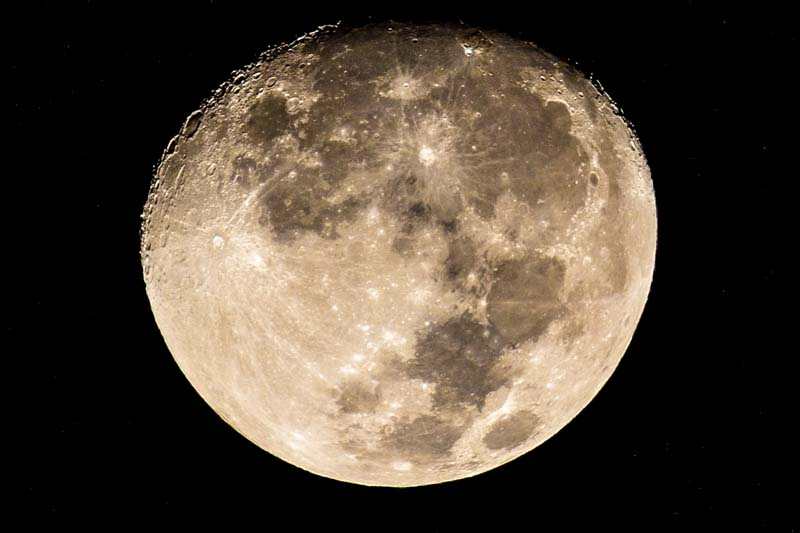
Die Nächte sind hell derzeit, bei fast Vollmond und klarem Himmel. Das ist gut für den Navigator, aber schlecht für die Sternenbeobachter. Aber nach dem Monduntergang erscheint wieder die Milchstraße. Dann dienen die Sternbilder Orion und der große Hund mit dem hellsten Stern der Nacht, dem Sirius, als Orientierung für den Steuermann. Ohne Streulicht können wir mit bloßem Auge Tausende von Sternen erkennen, so auch die Sternbilder Krebs, den Schützen, den großen Bär, die Zwillinge, die Jungfrau und den Skorpion. Nur das Kreuz des Südens versteckt sich noch unter dem Horizont.
Countdown Barbedos: 570 Seemeilen.

Day 16: Dinner is ready
Each evening between 7 and 8 pm, dinner is served. Fresh food always. Today, it’s olive oil fried cole (Kohl), omelet with onions and potatoes. Yes, there is one cook on board who combines olive oil with more things than most others would dare. However, this delicious dish might have been be the last purely vegetarian dinner for the next days. The two fishermen on board, obviously not bothered by three to five meter waves and twenty knots of wind, filled the fridge with twenty Mahi-Mahi (Goldmakrele) filet steaks.
Countdown to Barbedos: 700 miles.
Day 15: Morning after a long Nightwatch
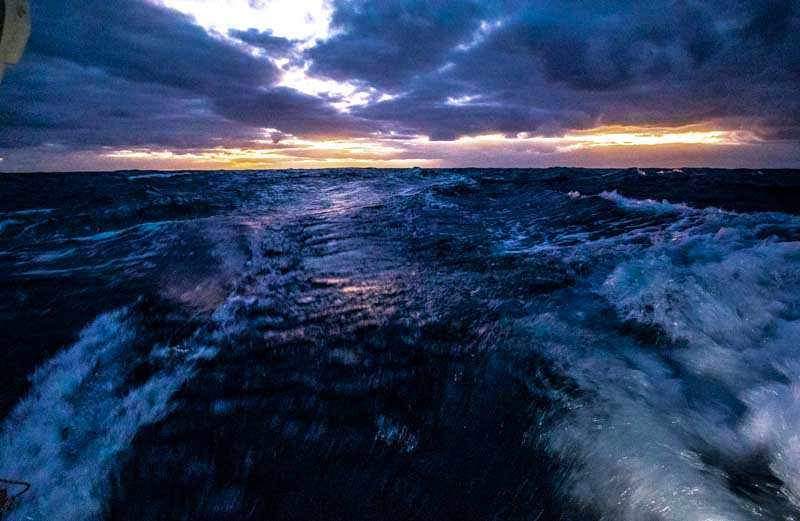
Nightwatches with the milky way above you can be fantastic. Orion and Sirius, or the moon, are leading the way. Dark cloudy nights with high waves and gusty winds, however, may make it difficult for two tired nightwatch sailors to set the right sails and to find the best route. Faced with a black sea and a black sky, they have to rely solely on instrumental navigation with monitors and displays. In the morning after such a challenging nightwatch, they look back to the east, watch the rising sun and count the miles they made to the west.
Day 14: Flying Fish and Squid
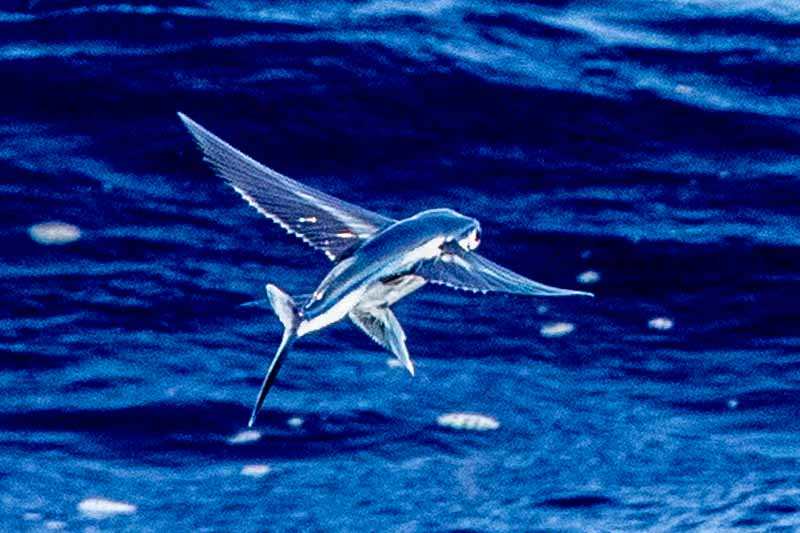
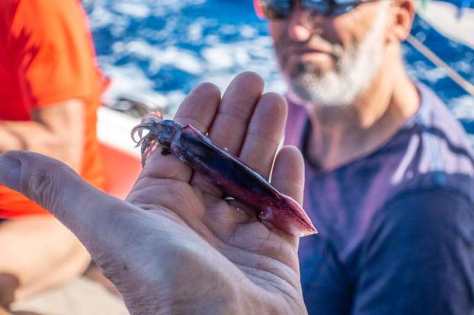
We are getting used to flying fishes that hit our boat. We consider them too small to eat. If they don’t themselves jump back into the sea we put them there. But we were quite astonished when five small squids (Tintenfische) simultaneously hit our boat. Probably they mistook Orinoco or our fishing lures for a predator like a Mahi Mahi or a Tuna. One squid landed next to the kitchen inside the boat. As it didn’t land inside the cooking pan, we also put it back into the ocean.
Day 13: Storm Sails
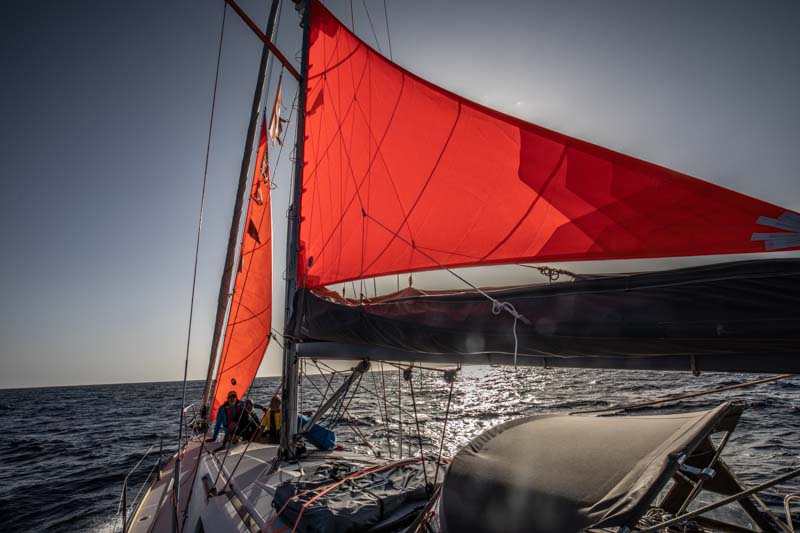
We have seven sails on board. Two of them we hope to never need: the storm jibe (Sturmfock) and the Trisail (Try-Segel). Both are very small, but strong. They are red, as in conditions above eight Beaufort visibility decreases. We did set these sails in light weather conditions as a part of our security training. Normally, there are no storms in this part of the Atlantic in winter. Even if, good weather predictions are available and would allow us to change our route to avoid storms. Nevertheless, it feels good to be prepared even for the most unlikely event.
Day 12: Mahi Mahi
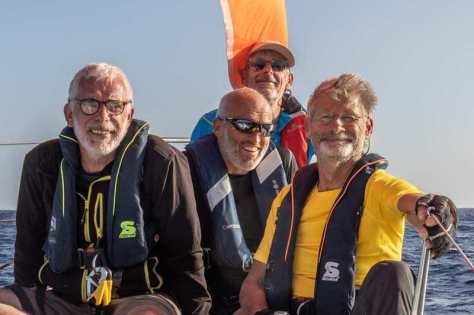
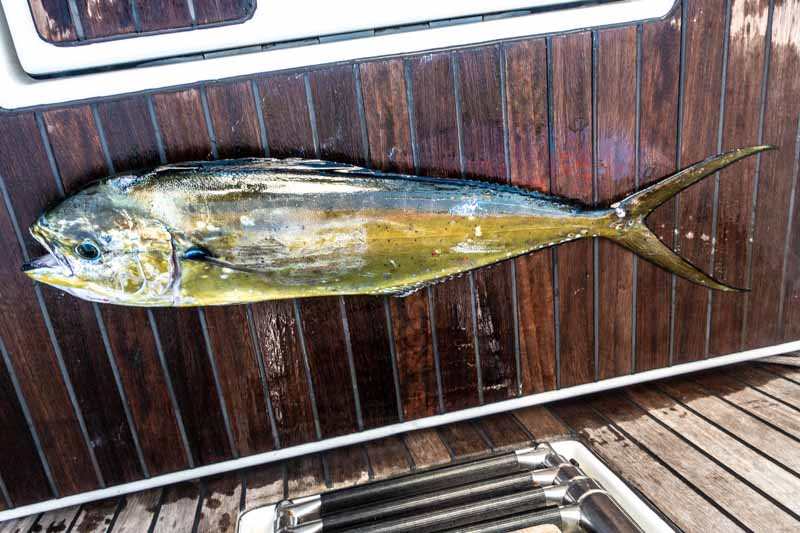
After eating tuna steaks every other day the last week, the crew was quite happy that the two big game enthusiasts on board caught two Mahi Mahis (Goldmakrele). It’s meat is firm, white and highly acclaimed by cooks. We also seem to be quite lucky with the weather. Good winds are predicted by our friend Alex, who is sending weather forecasts, and by our own downloaded weather grib files. Additionally, the captain of the freighter Sun Bird, on it’s way from the East Coast US to the Capverdian Islands, predicted fair winds on our way to the Caribbean Islands. It was the first and only ship so far we saw in our crossing.
 coconutmilk.de